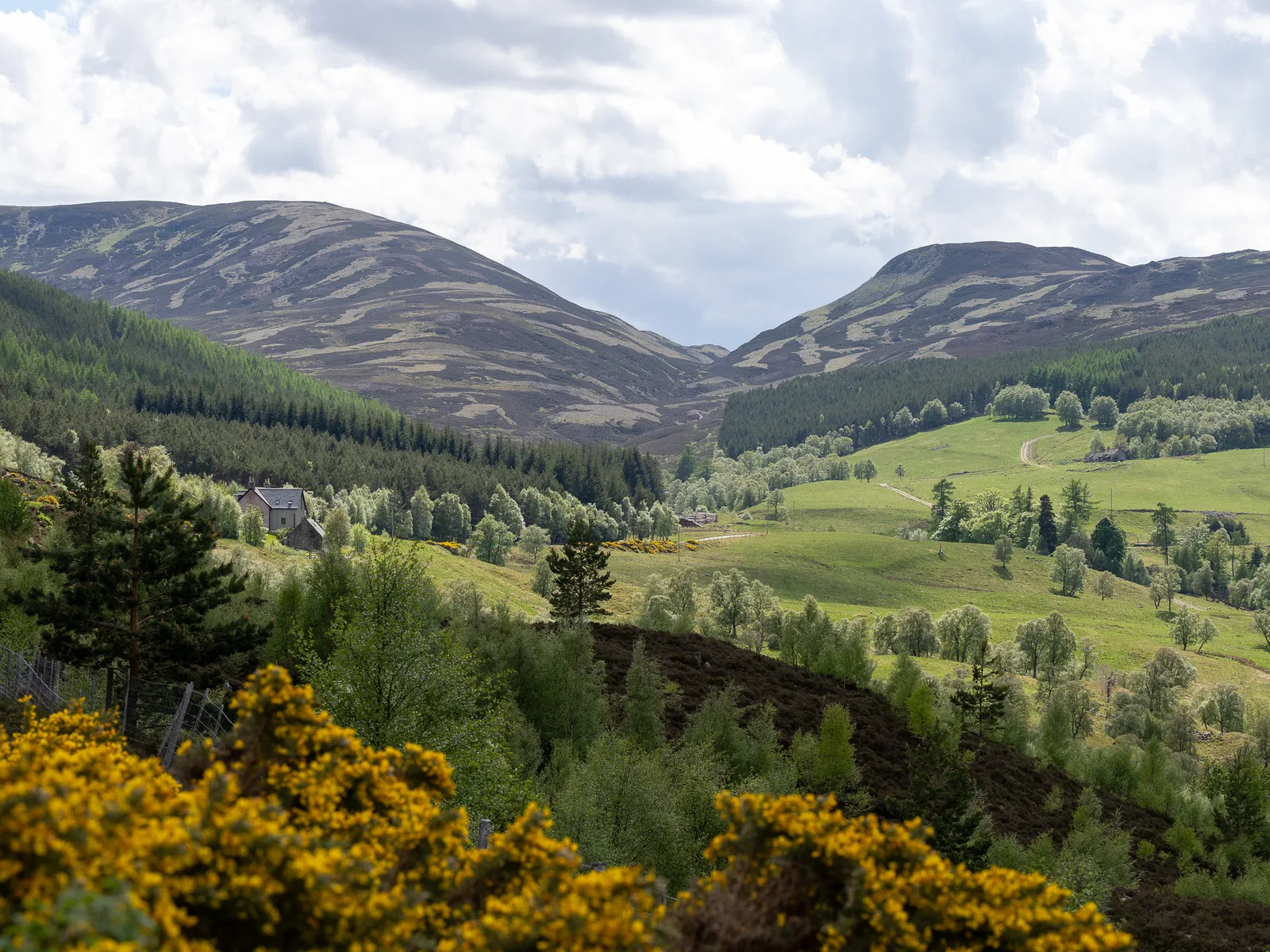
Nan Shepherd shaped Scottish culture quietly. She did not lead an army, formulate a physical law or hold political office. She taught English for more than four decades, wrote three novels and a poetry collection, walked repeatedly through the Cairngorms and wrote a book during the Second World War that remained unpublished for more than thirty years.
The Living Mountain eventually became one of Scotland’s most internationally recognised works of nature writing.
Its central idea was deceptively radical: a mountain is not an object placed there for a human being to conquer.
Cults and Aberdeen
Anna “Nan” Shepherd was born at Cults near Aberdeen on 11 February 1893. She spent most of her life within the north-east of Scotland, with Deeside and the Cairngorms forming part of her geographical and imaginative world.
She travelled abroad, but repeatedly returned to the same landscape. That repetition mattered. A place changes with weather, season and light, but the observer also changes. Shepherd’s subject became the relationship between person and landscape rather than scenery alone.
She graduated from the University of Aberdeen in 1915 and joined the institution that became Aberdeen College of Education as a lecturer in English. Her teaching career lasted about 41 years.
This is easy to overlook because modern readers know her primarily as a nature writer. For much of her adult life she was a teacher of teachers, influencing generations of people who entered Scottish classrooms.
The novelist
Shepherd’s first novel, The Quarry Wood, appeared in 1928, followed by The Weatherhouse in 1930 and A Pass in the Grampians in 1933.
These novels were rooted in north-east Scottish communities. Landscape mattered, but so did education, gender, class, religion, family and the limits placed upon women.
Modern celebration of The Living Mountain can make it seem that Shepherd had only one literary identity. She was already an established novelist before the book for which she is now most famous existed.
In the Cairngorms
Her poetry collection In the Cairngorms appeared in 1934. National Library manuscripts show that versions of the poems had been written over many years.
Shepherd’s serious mountain walking began by the late 1920s and included Ben Macdui. She travelled alone at times and with companions at others.
She was not Scotland’s first female mountaineer. Women had climbed Scottish mountains long before her. That claim would erase earlier women.
Her distinctive contribution was philosophical rather than chronological.
Not to the summit
Traditional mountaineering writing often treats a mountain as a challenge with a clear objective: reach the summit.
Shepherd increasingly rejected that relationship. The plateau mattered. Water mattered. Snow, animals, plants, light, wind and bodily sensation mattered. A person could spend time in a mountain environment without reducing the journey to a conquest.
She was interested in being inside the landscape rather than above it.
This is the idea that eventually made The Living Mountain feel extraordinarily modern.
The Living Mountain
Shepherd wrote The Living Mountain during the Second World War. It was not published until 1977, when she was 84.
The long delay has sometimes been turned into a simple story of a visionary woman rejected for thirty years. The evidence is less neat. She did not spend three decades continuously submitting the manuscript and receiving rejection letters.
The established fact is powerful enough: one of the books now central to her reputation existed unpublished for more than thirty years.
The work is not a conventional climbing memoir. It has no heroic expedition and no climactic conquest. Shepherd organised attention around water, snow, air, light, vegetation, animals, human senses and the physical body moving through landscape.
The observer is not outside nature. The observer is part of the experience being described.
Body and perception
Shepherd understood landscape physically. Feet meet rock. Cold enters skin. Wind alters balance. Water has temperature. Snow changes sound. Distance alters the eye.
This sensory attention helps explain why her writing crosses categories. It is nature writing, philosophy, memoir and poetry in prose without fitting entirely into any of them.
She was not a professional ecologist and should not be retroactively described as one. But she observed natural systems closely and developed an ecological sensibility in which humans were not masters standing outside nature.
The Cairngorms were not empty
Romantic landscape writing can erase human history by describing wilderness as though nobody lived or worked there.
The Cairngorms contain histories of settlement, Gaelic culture, estate ownership, agriculture, hunting, forestry, tourism and political conflict over land.
The Living Mountain is not a comprehensive history of those systems. Its focus is experiential. That is a limitation, not an accusation. No single book can be every possible book.
Literary networks and teaching
Shepherd was not a hermit. Her literary relationships connected her with writers including Helen Cruickshank, Willa Muir, Hugh MacDiarmid, William Soutar and Jessie Kesson.
Her friendship with Kesson is particularly significant because Shepherd encouraged another writer’s literary ambition. Cultural influence is not measured only in books published under one person’s name.
After retiring from teaching, Shepherd edited the Aberdeen University Review from 1957 to 1964. The University of Aberdeen awarded her an honorary degree in 1964.
Publication and rediscovery
When The Living Mountain finally appeared in 1977, it did not instantly produce the international reputation the book now enjoys. That reputation grew substantially later as the book was republished and championed by writers including Robert Macfarlane.
Calling Shepherd completely “forgotten” before the twenty-first century would also be inaccurate. Her work remained in libraries and Scottish literary circles. The later revival changed the scale of attention rather than resurrecting a person erased from existence.
Shepherd died on 23 February 1981, aged 88.
Her papers are now held by the National Library of Scotland and include correspondence, notebooks, poetry, manuscripts and typescripts.
The £5 note
In 2016 the Royal Bank of Scotland introduced a polymer £5 note featuring Shepherd.
That brought a once comparatively specialist literary figure into millions of everyday transactions and caused many people who had never encountered her work to ask who she was.
There is an irony in placing a writer who repeatedly diminished human claims over landscape on a symbol of economic value. But the banknote also demonstrates how dramatically her national reputation grew after her death.
Environmentalism without anachronism
Shepherd’s work resonates strongly with modern environmental thought. Landscape has value beyond exploitation. Attention matters. Humans exist inside natural systems rather than above them.
But she was not a modern climate activist and did not possess today’s scientific framework of anthropogenic climate change. Applying contemporary political labels directly to her would be anachronistic.
Her contribution is literary and philosophical.
SÙIL ALBA view
Shepherd asked a different question from the heroic mountaineer.
Not: how do I conquer the mountain?
But: what happens if I stay long enough to understand where I am?
That change of perspective outlived her. In an age with satellites, climate models and unprecedented environmental data, the failure to pay attention remains remarkably familiar.
Shepherd’s answer was simple and demanding: return, observe, notice change, and understand that the person looking belongs inside the landscape.
She wrote The Living Mountain in the 1940s. It appeared when she was 84. She died four years later. The enormous reputation came afterwards.
Knowing the mountain took time. Apparently, so did knowing Nan Shepherd.
Anna “Nan” Shepherd — 11 February 1893 to 23 February 1981. Teacher. Novelist. Poet. Walker. Nature writer. A Scot who shaped us.
Historical record
The National Library of Scotland holds Shepherd’s papers as MSS.27438–27445. Canongate documents the publication history of her novels, poetry and The Living Mountain. Royal Bank of Scotland records confirm the Nan Shepherd £5 note introduced in 2016.
THE SCOTS WHO SHAPED US is a permanent SÙIL ALBA historical journalism series. Achievement does not exempt a subject from scrutiny. Famous claims are checked against the surviving record, collaborators and opponents retain their place in the story, and later mythology is separated from evidence.
THE SCOTS WHO SHAPED US · No. 010 · NAN SHEPHERD