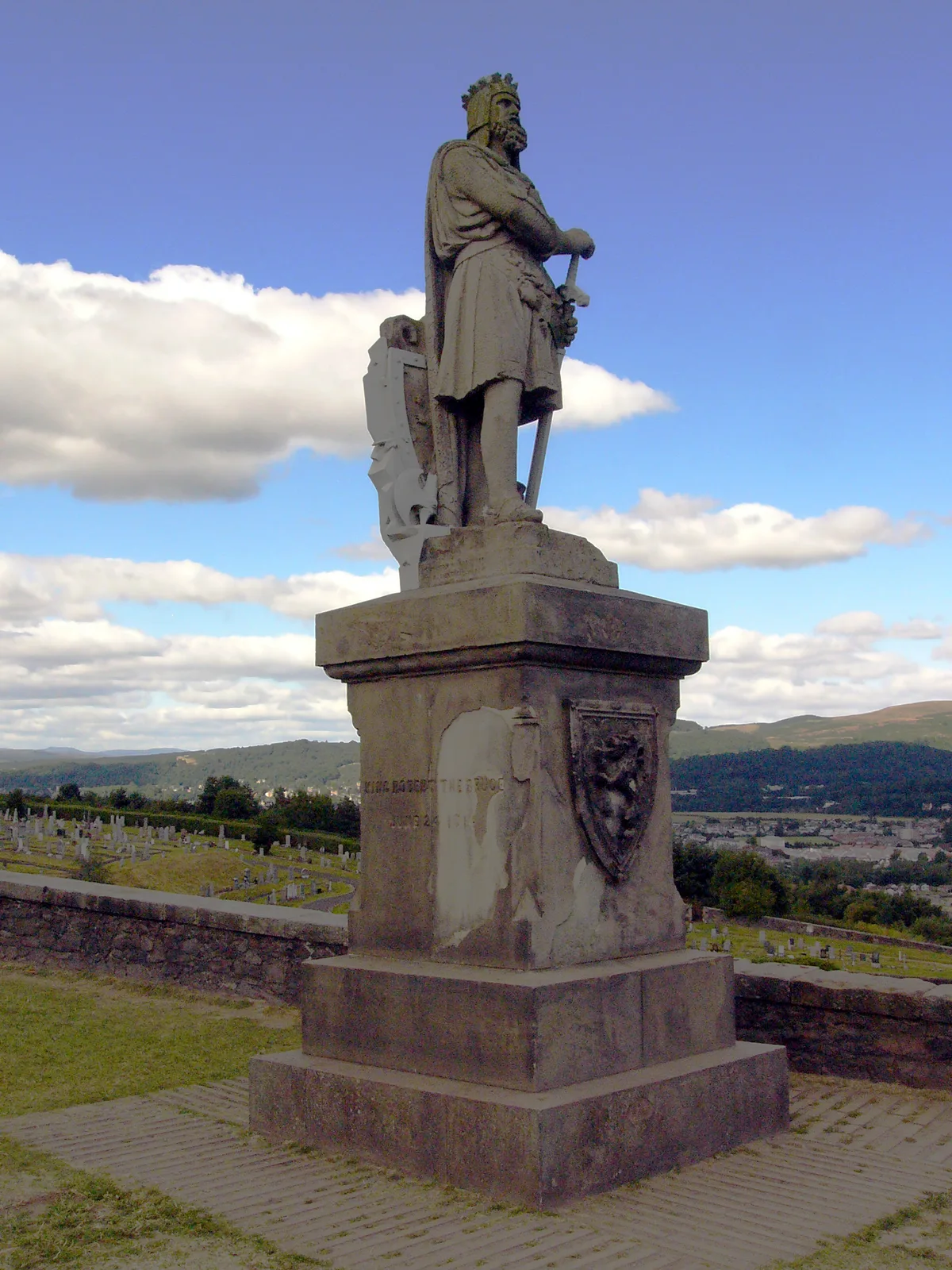
Robert the Bruce sits at the junction of documented medieval politics and centuries of patriotic storytelling. His name is attached to independence, Bannockburn, the Declaration of Arbroath and the spider that supposedly taught him perseverance.
The historical king is more complicated. Bruce shifted allegiances during the Wars of Independence and at times submitted to Edward I. He killed his Scottish rival John Comyn inside a church, seized a disputed crown and fought a Scottish civil war as well as English power. He devastated Buchan to break Comyn resistance. Bannockburn transformed his position but did not end the war. Formal English recognition of Scottish independence came only in 1328.
Removing the legend does not reduce Bruce. It makes his political recovery more remarkable.
Dynasty and succession
Robert Bruce was born on 11 July 1274, probably at Turnberry, although the precise birthplace is uncertain. His mother was Marjorie, Countess of Carrick; his father belonged to a powerful Bruce family with interests on both sides of the Anglo-Scottish border.
The death of Alexander III in 1286 and then Margaret, Maid of Norway, created a succession crisis. John Balliol and Robert Bruce’s grandfather were among the strongest claimants. Edward I of England was invited to help resolve the dispute but used the process to assert superiority over Scotland.
John Balliol became king in 1292. Relations with Edward deteriorated and England invaded in 1296.
Bruce did not always occupy one side
Modern national storytelling prefers lifelong consistency. Bruce’s real political career does not provide it.
He participated in Scottish resistance, served as a Guardian alongside John Comyn and Bishop William Lamberton, later submitted again to Edward I and in 1304 was associated with Edward’s siege of Stirling Castle.
Ten years later he would defeat Edward II nearby at Bannockburn.
Fact or Folklore: Was Bruce always a committed independence fighter?
No. His eventual role as king of an independent Scottish kingdom is clear, but his route there included changing allegiance and submission to Edward I.
John Comyn and the crown
On 10 February 1306 Bruce met John Comyn of Badenoch at Greyfriars church in Dumfries. The encounter ended with Comyn dead.
Later stories disagree over motive and the exact physical sequence, but Bruce was responsible for the killing. The dramatic version in which Comyn had betrayed a secret agreement to Edward I is much harder to prove.
Within weeks Bruce moved to claim the crown. He was inaugurated at Scone on 25 March 1306.
This was not a universally accepted national coronation. The Comyn network, Balliol supporters and other Scottish magnates opposed him. Edward I treated him as a rebel. Scotland’s war therefore contained a civil-war dimension from the beginning of Bruce’s kingship.
Near destruction
Bruce’s first campaign went catastrophically wrong. He was defeated at Methven in June 1306. Supporters were captured and executed. His wife, daughter and sisters entered English custody.
Bruce disappeared from the immediate record for a time. This period later became the setting for the spider legend.
The National Trust for Scotland treats the famous cave-and-spider story as legend. No contemporary evidence proves that Bruce watched a spider repeatedly fail and then drew a lesson from it.
Bruce really did suffer disastrous defeat and recover. The spider is unnecessary.
Return and civil war
Bruce returned to campaigning in 1307. Edward I died that year and Edward II proved a weaker opponent.
Bruce turned aggressively against Scottish rivals. In 1308 he defeated Comyn power in the north-east and devastated Buchan in the campaign remembered as the Harrying of Buchan.
The exact civilian death toll cannot be reconstructed reliably, but the destruction of settlements, estates and the Comyn territorial base is not seriously disputed.
This matters because national heroes are often granted violence that defines their enemies. Bruce should not receive that exemption.
Castles and asymmetric strategy
Bruce often destroyed castles after capturing them. The logic was strategic. England had greater resources and could reoccupy fortified positions. If Scotland could not hold every strongpoint, destroying fortifications denied them to a future enemy.
The policy reshaped Scotland’s physical landscape but made sense within an asymmetric war.
Bannockburn
Edward II marched north in 1314 to relieve Stirling Castle. Bruce’s army met the English on 23 and 24 June.
The Scottish infantry, organised in mobile schiltrons, used terrain and disciplined spear formations effectively. English forces became compressed and their army collapsed. Edward II escaped.
Bannockburn made Bruce the dominant ruler of Scotland and shattered English military authority there.
It did not end the war.
Formal English recognition of Scottish independence was still fourteen years away.
The famous story of Bruce personally killing Henry de Bohun with an axe comes principally through John Barbour’s The Brus, written decades after the battle. It is an important medieval tradition, not an eyewitness transcript.
Ireland
Bruce’s ambitions were not limited to defending Scotland. His brother Edward Bruce invaded Ireland in 1315 and was proclaimed High King by supporters. Robert later joined the campaign.
The strategy aimed to weaken English power and perhaps create a broader Gaelic political alliance, but the war compounded suffering during a period of severe famine. Edward Bruce was killed at Faughart in 1318 and the campaign collapsed.
This complicates any simple image of the Bruce dynasty as only resisting external domination. Medieval rulers could oppose imperial power and project their own power elsewhere.
The Declaration of Arbroath
On 6 April 1320 a letter was sent to Pope John XXII in the name of Scotland’s barons and community of the realm. The surviving Scottish file copy is held by National Records of Scotland.
The Declaration asserted Scotland’s status as an independent kingdom and defended Robert’s kingship. Its famous language about fighting for freedom and its conditional statement that the king could be replaced if he submitted to English domination are historically remarkable.
But it was not a modern democratic constitution or a declaration of popular sovereignty in the twenty-first-century sense. It was a sophisticated medieval diplomatic document produced within aristocratic politics.
Bernard, Abbot of Arbroath, is generally considered the likely drafter.
Recognition
The Pope recognised Bruce as King of Scots in 1324. England remained the final diplomatic obstacle.
The Treaty of Edinburgh–Northampton in 1328 recognised Scotland as an independent kingdom and Robert as its rightful king.
This, rather than Bannockburn alone, marks the formal political achievement.
The peace was fragile. War resumed after Bruce’s death.
Illness and leprosy
Bruce suffered serious chronic illness in his later years. For centuries it has often been called leprosy.
Modern University of Glasgow research treats leprosy as plausible rather than proven. A skull cast associated with remains found at Dunfermline shows features that may be compatible with the disease, but the identity and diagnosis cannot be established with absolute certainty.
SÙIL ALBA therefore will not state that Bruce definitely had leprosy.
Death, body and heart
Bruce died at Cardross on 7 June 1329, about a year after the treaty that recognised his kingdom. His body was buried at Dunfermline Abbey.
His heart was removed for a crusading journey led by Sir James Douglas. Douglas died fighting in Spain in 1330 and the heart was eventually returned to Scotland and buried at Melrose Abbey.
The romantic story of Douglas throwing the casket containing Bruce’s heart ahead of him in battle is later heroic tradition rather than secure contemporary evidence.
SÙIL ALBA view
The historical Bruce is more politically flexible, more violent and more fallible than the statue. That does not reduce his achievement.
In 1306 his kingship looked close to destruction. His army had been defeated, his family captured and powerful Scots rejected him.
By 1328 England formally recognised him as king of an independent Scotland.
That reversal required military ability, ruthlessness, diplomacy, state-building and persistence. The spider can go. The real history is stronger.
Robert I — Robert the Bruce. 11 July 1274 to 7 June 1329. Nobleman. Rebel. Warrior. King. State-builder. A Scot who shaped us.
Historical record
Principal sources include Historic Environment Scotland’s battlefield and site histories, National Records of Scotland material on the Declaration of Arbroath and Treaty of Edinburgh–Northampton, and the University of Glasgow’s modern research into the Dunfermline remains and disputed leprosy diagnosis.
THE SCOTS WHO SHAPED US is a permanent SÙIL ALBA historical journalism series. Achievement does not exempt a subject from scrutiny. Famous claims are checked against the surviving record, collaborators and opponents retain their place in the story, and later mythology is separated from evidence.
THE SCOTS WHO SHAPED US · No. 009 · ROBERT THE BRUCE