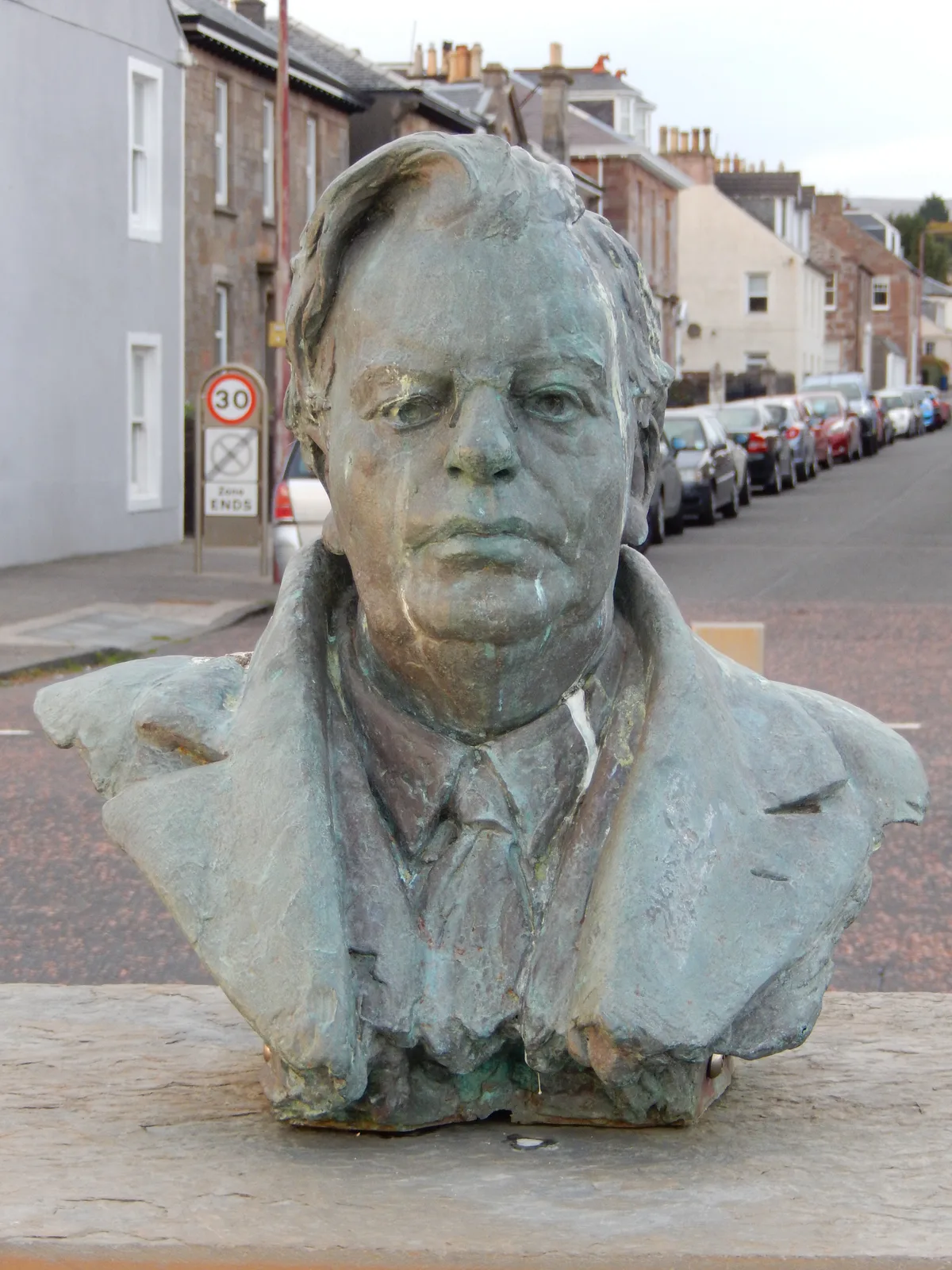
John Logie Baird is usually introduced in Scotland as “the inventor of television”. That description is understandable but too absolute. Television emerged from decades of international work in scanning, optics, photoelectric materials, radio, amplification and cathode-ray technology.
Baird’s defensible achievement is already enormous: he made moving television images work publicly, pushed television into broadcasting, demonstrated long-distance and transatlantic transmission, experimented with colour, stereoscopic and infrared television, and helped transform television from an idea into a medium serious institutions had to confront.
Helensburgh and engineering
Baird was born in Helensburgh on 13 August 1888, the youngest child of the Reverend John Baird and Jessie Morrison Inglis. He studied engineering in Glasgow, but poor health disrupted his education and later prevented military service during the First World War.
Before television he tried a succession of business ventures. Some worked temporarily; others failed. That commercial experience mattered because invention alone would never make television a mass medium. Capital, publicity, manufacturing and institutional access would become as important as technical ingenuity.
Television existed before Baird
Paul Nipkow had patented a mechanical scanning disc in the nineteenth century. Selenium photoelectric properties were known. Karl Ferdinand Braun, Boris Rosing, Alan Archibald Campbell-Swinton, Charles Francis Jenkins, Philo Farnsworth, Vladimir Zworykin and others contributed to the international development of television.
Baird therefore did not begin with nothing.
His challenge was practical: could recognisable moving human images actually be transmitted and reconstructed with the technology available in the early 1920s?
Hastings, Stooky Bill and crude machinery
Baird worked seriously on mechanical television while living in Hastings. His systems used rapidly rotating scanning discs, photoelectric conversion and synchronised reconstruction.
The technology was barely adequate. Light sensitivity was poor, amplification limited and illumination extreme. Baird used the ventriloquist dummy “Stooky Bill” because a painted high-contrast face tolerated the lighting better than a human subject.
The apparatus could look improvised — early machines incorporated repurposed objects — but the underlying problem was sophisticated. A visual scene had to be scanned line by line, converted into an electrical signal and recreated as motion.
26 January 1926
Baird’s decisive public moment came on 26 January 1926, when he demonstrated recognisable moving television images to members of the Royal Institution and journalists in London.
The National Science and Media Museum identifies this as the first public demonstration of true television.
That wording is important. Earlier image-transmission experiments existed. Baird’s distinction is not “first electrical image ever transmitted”, but a practical public demonstration of recognisable moving tonal images.
Fact or Folklore: Did Baird invent television entirely by himself?
No. Television was a multi-inventor international development. Baird was one of its principal practical pioneers.
Distance, recording and colour
In May 1927 Baird transmitted television pictures from London to Glasgow over telephone lines, demonstrating that television could become telecommunications rather than merely a room-scale laboratory effect.
He also experimented with recording television signals onto discs in a system called Phonovision. The system did not become modern video recording, but it represents an early serious attempt to preserve television rather than letting the image disappear at transmission.
In 1928 Baird demonstrated transatlantic television, colour television and stereoscopic television. He also experimented with infrared imaging under the name Noctovision.
These systems were primitive by modern standards, but the range of experimentation is remarkable. Baird was exploring future television capabilities while basic black-and-white television itself remained uncertain.
BBC scepticism
A working machine did not guarantee broadcasting. The BBC had been built around radio and remained cautious about Baird’s low-resolution system.
Baird needed access to transmitters. Eventually experimental BBC transmission began, and regular 30-line broadcasts followed in 1929. By 1932 the BBC was producing programmes for the low-definition service.
Television audiences began not in millions but in tiny numbers of enthusiasts with expensive equipment.
The system loses
Once Baird proved television plausible, much larger institutions had reason to invest in competing systems.
Mechanical scanning had hard limits. Fully electronic television offered higher resolution and more flexible cameras. Philo Farnsworth developed electronic television in the United States. Vladimir Zworykin and RCA worked on electronic camera systems. In Britain, EMI under Isaac Shoenberg developed electronic television technology.
In 1936 the BBC launched a high-definition service from Alexandra Palace using two systems in alternating trials: Baird’s 240-line system and Marconi-EMI’s 405-line electronic system.
On 6 February 1937 the Baird system was abandoned.
The electronic system was better suited to continued broadcasting.
Fact or Folklore: Did the establishment simply steal television from Baird?
That explanation is too simple. Corporate resources and institutional politics mattered, but electronic television also had genuine technical and operational advantages.
Baird’s mechanical line did not become the dominant ancestor of modern television.
Why failure does not erase the achievement
The critical historical change had already occurred. In the early 1920s television could still be dismissed as speculative. By the mid-1930s governments, broadcasters and major electronics companies were competing over which system should carry a new mass medium.
Baird helped cause that shift.
He continued researching colour and higher-definition systems after losing the BBC standards battle. He died on 14 June 1946, aged 57, before television became the dominant domestic medium of the post-war era.
SÙIL ALBA view
Baird does not need the title “sole inventor of television”. It weakens rather than strengthens the history.
Give Nipkow, Campbell-Swinton, Farnsworth, Zworykin, Shoenberg and countless engineers their credit. Admit that Baird’s mechanical technology lost.
What remains is still extraordinary.
A Scottish engineer with fragile health and limited resources made recognisable moving television work publicly, sent images over hundreds and then thousands of miles, experimented with colour and three dimensions, pushed broadcasters onto the air and helped turn television from speculation into an industry worth fighting over.
John Logie Baird — 13 August 1888 to 14 June 1946. Engineer. Inventor. Entrepreneur. Television pioneer. A Scot who shaped us.
Historical record
The principal source for the technological chronology is the National Science and Media Museum / Science Museum Group, whose collections and histories document Baird’s apparatus, the 1926 demonstration, long-distance and transatlantic transmissions, colour and stereoscopic work, BBC broadcasting and the eventual victory of electronic television.
THE SCOTS WHO SHAPED US is a permanent SÙIL ALBA historical journalism series. Achievement does not exempt a subject from scrutiny. Famous claims are checked against the surviving record, collaborators and opponents retain their place in the story, and later mythology is separated from evidence.
THE SCOTS WHO SHAPED US · No. 008 · JOHN LOGIE BAIRD