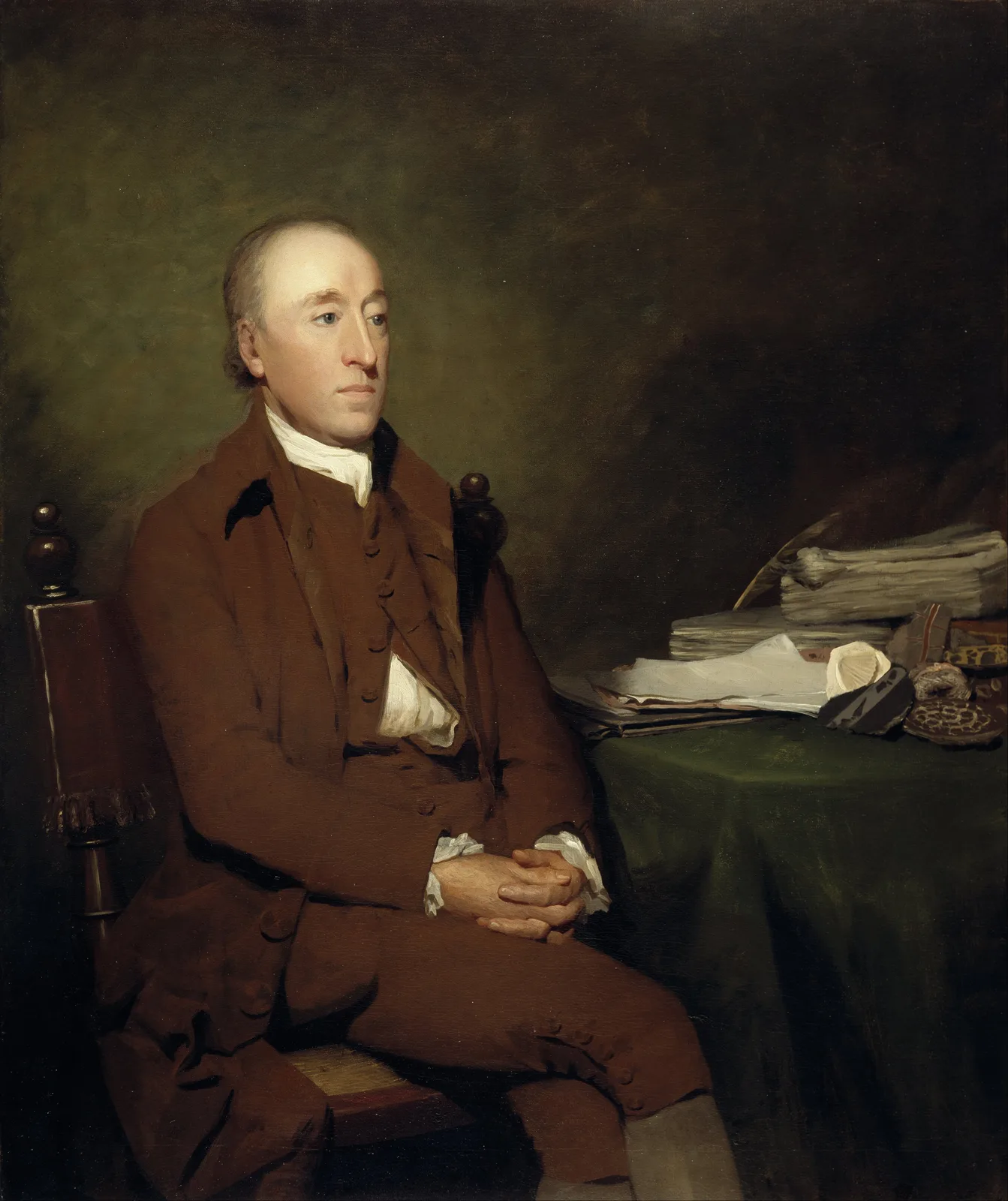
James Hutton helped change the scale on which human beings understand their place in the world. He did not calculate Earth’s modern age of roughly 4.54 billion years, and he did not invent geology alone. His achievement was to show that ordinary geological processes, operating repeatedly over immense periods, could explain the structure of the landscape.
That required a history far longer than conventional short chronologies could comfortably accommodate.
Edinburgh, medicine and chemistry
Hutton was born in Edinburgh on 3 June 1726, the son of Sarah Balfour and William Hutton, a merchant and former city treasurer. He attended Edinburgh High School and entered the University of Edinburgh at about fourteen.
His first attempted career was law, but chemistry interested him far more than legal work. He returned to medical study, continued his education in Paris and received an MD from Leiden in 1749.
He never became famous as a practising physician. With his friend James Davie, he developed a profitable process for producing sal ammoniac from soot. The business provided financial independence and gave Hutton time to pursue agriculture, travel and natural philosophy.
This material context matters. Scientific freedom is easier when a person has the resources to observe, experiment and think without depending on a university salary.
The farmer becomes a geologist
Hutton inherited farms in Berwickshire and spent years studying agricultural improvement. Farming made soil, drainage, erosion and sediment practical concerns rather than abstract ideas.
He saw material move through landscapes. Rivers carried sediment. Weather wore down rock. Soil depended upon continuing processes. The Earth began to look less like a static creation and more like a system.
By the 1760s Hutton was travelling through Scotland examining rocks and landforms. He returned permanently to Edinburgh in 1768 and entered the intellectual world of the Scottish Enlightenment. His associates included Joseph Black, Adam Smith and John Playfair.
When the Royal Society of Edinburgh was founded in 1783, Hutton became a founding Fellow.
Theory of the Earth
Hutton’s geological theory was presented to the Royal Society of Edinburgh in 1785 and published in its Transactions in 1788.
His model emphasised cycles. Land is worn down. Sediment is transported and deposited. Sediment becomes rock. Internal heat and geological forces raise rock to form new land. Weathering begins again.
The important implication was time. These processes were slow. Thick rock sequences, uplift, deformation and erosion could not fit comfortably inside a short history of the planet.
Hutton did not know Earth’s numerical age. He established the need for immense geological duration — what later generations call deep time.
Fact or Folklore: Did Hutton discover that Earth is 4.54 billion years old?
No. Radiometric dating and modern geophysics came much later. Hutton’s contribution was establishing a geological framework that required vast time.
Salisbury Crags
Edinburgh itself provided evidence. At Salisbury Crags, near Arthur’s Seat, Hutton examined igneous material intruding into sedimentary rock. The relationships helped challenge geological theories that treated almost all rock as material precipitated from a primordial ocean.
Heat mattered. Molten material mattered. Earth’s interior mattered.
A landscape within walking distance of central Edinburgh became evidence about planetary history.
Siccar Point
Hutton’s most famous field evidence lies on the Berwickshire coast at Siccar Point. In 1788 he visited with John Playfair and Sir James Hall.
There older greywacke strata stand steeply tilted beneath younger red sandstone lying at a different angle. The boundary is an unconformity.
To create that structure, the older sediments first had to accumulate and harden. They were then deformed, uplifted and eroded. Only afterwards were younger sediments deposited above them and hardened in turn.
Each stage required time. Together they represented an almost inconceivable sequence of geological history.
Hutton did not “discover” the physical location. People obviously knew the coast existed. His achievement was recognising what the rocks meant.
“No vestige of a beginning”
Hutton’s famous phrase — “no vestige of a beginning,—no prospect of an end” — is often misread as a scientific proof that Earth had literally existed forever. That was not what his observations established. He meant that the geological cycles available to him showed no observable starting point.
Modern planetary science tells us Earth did have a beginning. Hutton’s point was epistemic: within the rock record he could see cycles extending beyond the historical horizon available to him.
Religion and geology
Hutton is sometimes turned into a modern atheist hero defeating biblical religion. That is historically inaccurate. He believed in a creator. His geology conflicted with literal short chronologies but did not require him to abandon religious belief.
As with Maxwell, historical people should not be recruited carelessly into present-day culture wars.
Uniformitarianism
Hutton’s work later became associated with uniformitarianism: the principle that processes observable in the present can help explain the geological past.
The slogan “the present is the key to the past” is associated with later geological tradition rather than being a direct Hutton quotation. He also did not prove that all geological change is slow. Modern geology recognises both gradual processes and catastrophes such as impacts, earthquakes and enormous volcanic episodes.
His central contribution survives: Earth history can be reconstructed through natural processes rather than requiring a sequence of unexplained singular events.
John Playfair
Hutton had a major communication problem. His prose could be extremely difficult. After his death, John Playfair published Illustrations of the Huttonian Theory of the Earth in 1802 and presented Hutton’s ideas with much greater clarity.
Playfair deserves significant credit. Intellectual history often remembers the person who originates an idea and forgets the person who makes it understandable.
Charles Lyell later developed geological ideas in Principles of Geology. Darwin carried Lyell’s work on the voyage of the Beagle. Deep geological time became crucial to evolutionary thinking because gradual biological change requires enormous periods.
Hutton did not invent Darwinism. He helped create the geological world in which Darwin’s theory could operate.
Limits and errors
Hutton did not know plate tectonics. He could not date rocks radiometrically. His mechanical explanations were incomplete. His philosophical book An Investigation of the Principles of Knowledge was enormous and largely unsuccessful.
Calling him the “father of modern geology” is useful shorthand, but geology had many parents: Nicolas Steno, Abraham Werner, William Smith, Lyell and others contributed foundational work.
A stronger formulation is that Hutton was one of the decisive figures in transforming geology into a science of a dynamic and immensely ancient Earth.
SÙIL ALBA view
Hutton’s deepest achievement was not a number. It was a scale.
He looked at rain, soil, rivers, sediments, cliffs and rock contacts and realised that ordinary processes become extraordinary when allowed enough time. Scotland supplied the evidence: Salisbury Crags, Arran, the Borders and especially Siccar Point.
The cliff became a clock.
Hutton learned to read it.
James Hutton — 3 June 1726 to 26 March 1797. Farmer. Physician. Chemist. Natural philosopher. Geologist. The Scot who helped humanity discover deep time.
Historical record
Principal sources include the Royal Society of Edinburgh’s Hutton archive and tercentenary material, the University of Edinburgh’s biographical and plaque records, and National Museums Scotland.
THE SCOTS WHO SHAPED US is a permanent SÙIL ALBA historical journalism series. Achievement does not exempt a subject from scrutiny. Famous claims are checked against the surviving record, collaborators and opponents retain their place in the story, and later mythology is separated from evidence.
THE SCOTS WHO SHAPED US · No. 006 · JAMES HUTTON