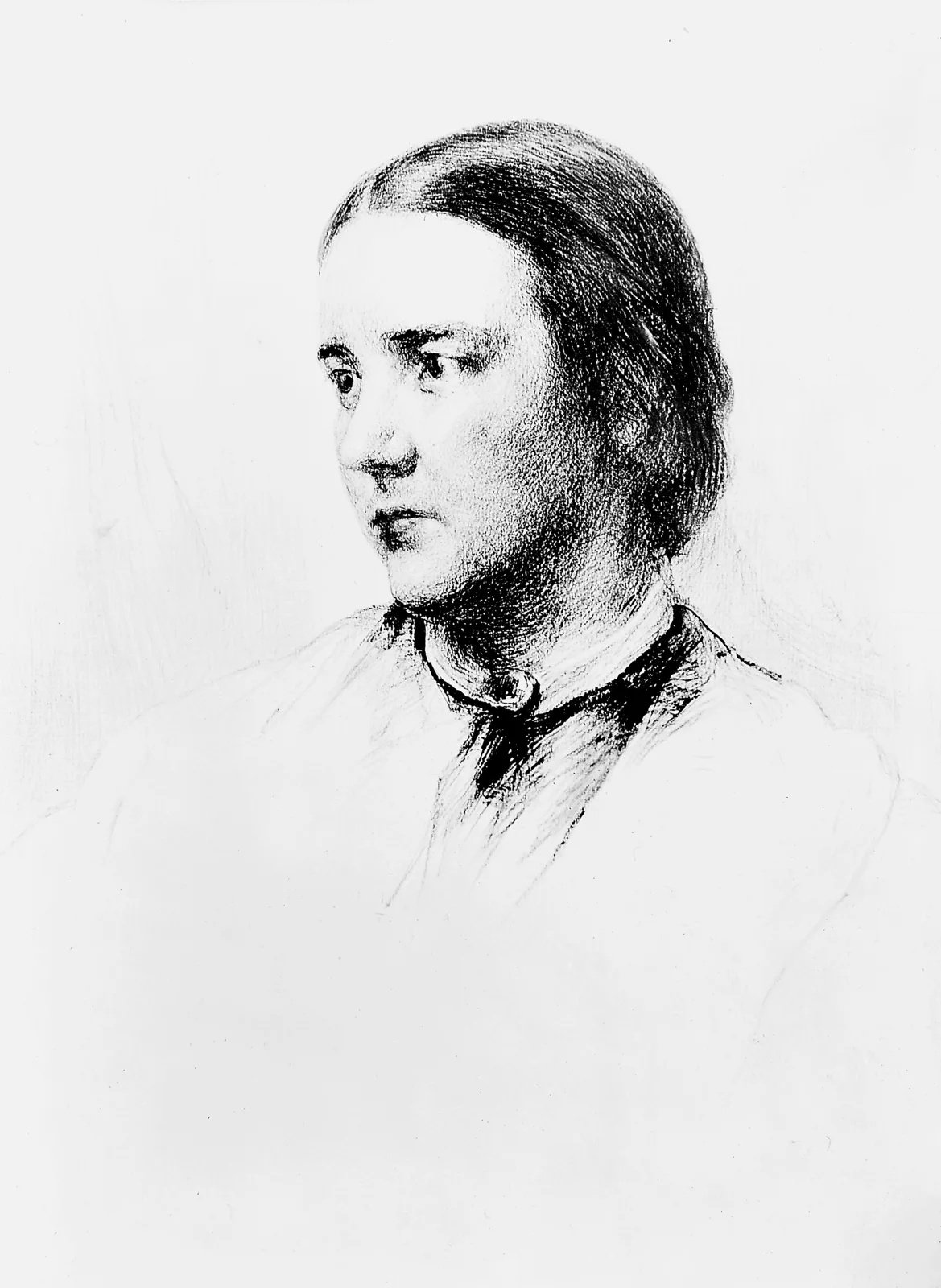
Sophia Jex-Blake is easy to turn into a simple hero: a woman applies to study medicine, a university tries to stop her, she refuses, other women join her, a hostile crowd confronts them, and she eventually helps build institutions in which women can train and practise medicine.
That story is substantially true. It is also incomplete. Jex-Blake could be controlling and combative. Students rebelled against her leadership, and one of the women who eventually helped create a rival medical school was Elsie Inglis. The same qualities that made Jex-Blake extraordinarily difficult for hostile institutions to defeat could make her extraordinarily difficult to work with.
Her historical importance survives that criticism.
From education to medicine
Sophia Louisa Jex-Blake was born in Hastings in 1840. She studied at Queen’s College in London and became a mathematics tutor there in 1859. Her family initially resisted both higher education and the idea that she should be paid for intellectual work.
Travel to the United States exposed her to women already participating in medical institutions, including the New England Hospital for Women and Children. She became convinced that medicine should be her profession.
Britain presented a structural problem. Medical qualification increasingly depended upon universities, hospitals, examinations and licensing bodies. If those institutions refused women access, women could be excluded before their competence was ever tested.
Edinburgh and the Seven
In 1869 Jex-Blake applied to the University of Edinburgh to study medicine. The Faculty was prepared to accept her, but institutional arrangements for teaching a single woman were deemed impractical. The logic was circular: she could not study with men because she was a woman, and separate provision was said to be unreasonable because she was only one woman.
Jex-Blake responded by finding more women.
Mary Anderson, Emily Bovell, Matilda Chaplin, Helen Evans, Edith Pechey and Isabel Thorne joined her. Together they became known as the Edinburgh Seven. The University of Edinburgh describes them as the first group of matriculated female undergraduate students at a British university.
Matriculation did not mean equality. Women faced separate classes, higher practical barriers, restricted clinical access and continuing hostility.
Surgeons’ Hall
On 18 November 1870 the women went to Surgeons’ Hall to sit an anatomy examination. A hostile crowd gathered, abused them and attempted to obstruct their entry. Mud and other material were thrown. The women eventually reached the examination and sat it.
The event became known as the Surgeons’ Hall riot. It is well documented in University of Edinburgh and Royal College histories and should not be dismissed as later feminist folklore.
The violence also clarified the dispute for the public. Whatever arguments opponents made about administrative practicality or educational standards, people could now see men physically trying to prevent women from sitting an examination.
The legal defeat
Institutional resistance hardened. The dispute reached the Court of Session, where the women lost in 1873. They would not receive Edinburgh medical degrees despite years of study and examination.
This was a genuine defeat. Yet the campaign transformed women’s medical education into a national political issue. Legislation in 1876 allowed medical examining bodies to admit women to professional examinations, although it did not force every body to do so.
Jex-Blake helped establish the London School of Medicine for Women in 1874. She eventually obtained an MD from the University of Bern and a licence through the King’s and Queen’s College of Physicians of Ireland in 1877, allowing her to register as a medical practitioner.
The irony is obvious: a woman who had studied for years in Edinburgh had to leave Britain to secure the qualification that allowed her to return as a recognised doctor.
Building healthcare in Edinburgh
Jex-Blake returned to Edinburgh, opened a practice and in 1878 established the Edinburgh Provident Dispensary for Women and Children. The institution expanded and in 1885 became the Edinburgh Hospital and Dispensary for Women and Children, with inpatient beds and medical staff drawn from women.
This mattered in two directions. Women patients gained access to care, and women doctors gained clinical opportunities.
The institution eventually developed into Bruntsfield Hospital, which survived until 1989. That is a substantial legacy: a campaign about access to medicine became an institution that treated patients for more than a century.
The Edinburgh School of Medicine for Women
In 1886 Jex-Blake founded the Edinburgh School of Medicine for Women. It attracted students from Britain and overseas. One was Elsie Inglis.
This is where the biography becomes uncomfortable. Jex-Blake’s leadership was highly controlling. Disputes over discipline and school rules became serious. Students Ina and Grace Cadell fought her in court; Jex-Blake lost. Other students rebelled.
Elsie Inglis became associated with the creation of a rival Edinburgh College of Medicine for Women.
Fact or Folklore: Was Elsie Inglis simply Jex-Blake’s loyal protégé?
No. Jex-Blake helped create the route through which Inglis entered medicine, but their institutional relationship ended in serious conflict.
The episode illustrates a recurring historical problem. People can understand exclusion vividly when they are excluded, then fail to recognise the effects of power when they control an institution themselves.
Women finally graduate
Legislative and university reform gradually opened Scottish higher education. By the 1890s women were entering degree structures that the Edinburgh Seven had been denied decades earlier. Jex-Blake’s own school eventually closed in 1898 as mainstream access improved and rival provision expanded.
In 2019 the University of Edinburgh awarded posthumous honorary degrees to the Edinburgh Seven, formally recognising women whom the institution’s predecessors had blocked.
That ceremony could not restore the lost careers or years, but it made the institutional reversal explicit.
Margaret Todd and later life
Jex-Blake retired in 1899 and lived at Windydene in Sussex with Dr Margaret Todd, a former student, doctor and writer who later became her biographer. Modern historians have examined Jex-Blake’s close relationships with women within queer history. The evidence supports profound and enduring female companionship, but imposing a precise modern sexual identity upon a nineteenth-century woman who did not use that language would exceed the record.
Jex-Blake remained committed to women’s rights and suffrage. She died on 7 January 1912, before equal parliamentary voting rights for women.
SÙIL ALBA view
Jex-Blake was formidable because she was difficult to stop. That same characteristic could make her difficult to work with. She fought a university, organised other women, survived legal defeat, qualified abroad, opened a dispensary, created a hospital and founded a medical school. Then younger women rebelled against her management.
The contradiction does not erase the achievement. It makes it useful.
She was right about the central question: women were capable of studying medicine, practising medicine, running hospitals and carrying professional responsibility. The institutions resisting her were wrong, and eventually even those institutions admitted it.
Jex-Blake was born in England, not Scotland. She belongs in this series because the defining struggle and institutional legacy of her life are embedded in Edinburgh and Scottish medicine.
Sophia Louisa Jex-Blake — 1840 to 7 January 1912. Physician. Campaigner. Institution-builder. Difficult reformer. A woman who shaped Scotland.
Historical record
Principal sources include the University of Edinburgh’s histories of Jex-Blake and the Edinburgh Seven, the Royal College of Physicians of Edinburgh, Lothian Health Services Archive, and Edinburgh Law School material on Jex-Blake v Senatus of Edinburgh University.
THE SCOTS WHO SHAPED US is a permanent SÙIL ALBA historical journalism series. Achievement does not exempt a subject from scrutiny. Famous claims are checked against the surviving record, collaborators and opponents retain their place in the story, and later mythology is separated from evidence.
THE SCOTS WHO SHAPED US · No. 005 · SOPHIA JEX-BLAKE