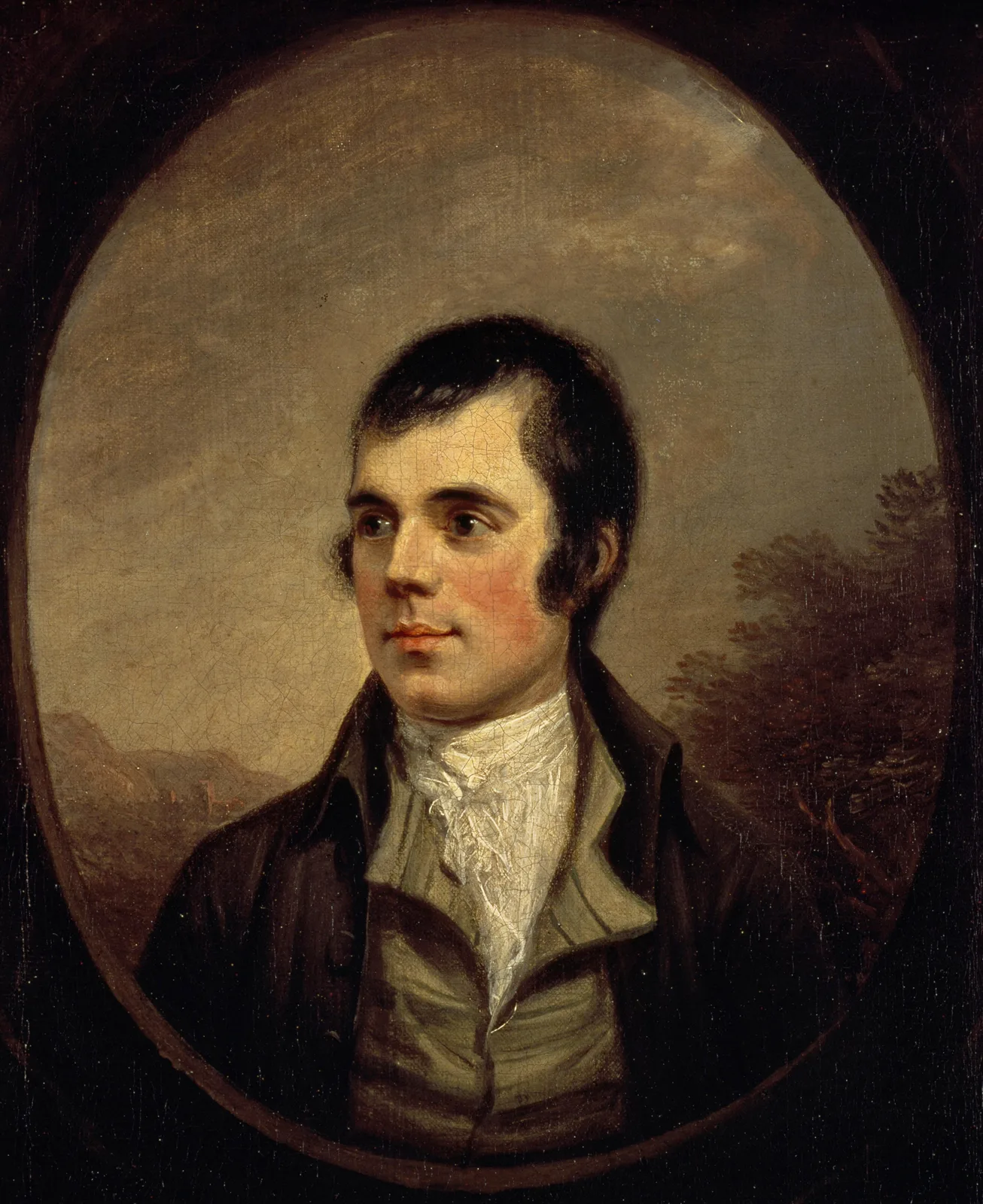
Robert Burns is difficult to write about honestly because Scotland has spent more than two centuries turning him into something larger than a historical person. Every January his words are recited, haggis is carried into rooms, whisky is poured and “Auld Lang Syne” is sung around the world. He became not merely a poet but part of Scotland’s cultural machinery.
The historical Burns was more complicated. He was a farmer, poet, songwriter and excise officer. He could write with extraordinary force about inequality, hypocrisy, love, sex, religion and human fellowship. He was also ambitious, financially insecure and personally chaotic. He fathered children outside marriage, maintained overlapping relationships and seriously planned to take employment in Jamaica within a plantation economy dependent on enslaved labour. His radical sympathies coexisted with government employment. His global cultural legacy grew partly from material he adapted from older Scottish song traditions.
None of those contradictions make his achievement smaller. They make the achievement real.
Alloway and education
Burns was born on 25 January 1759 in Alloway, Ayrshire, the son of William Burnes and Agnes Broun. His father was a tenant farmer and the family experienced genuine financial strain. But the familiar image of Burns as an entirely untutored “ploughman poet” is misleading. William Burnes valued education and helped arrange schooling for his children. Robert received instruction in reading, writing, arithmetic and other subjects and became an extensive reader.
The rural environment mattered profoundly. Farming shaped Burns’s language and imagery, but so did books, religion, local song traditions and the Scots spoken around him. He wrote in Scots, English and mixed registers rather than in a single linguistic mode. That flexibility allowed him to speak both to local Scottish audiences and to a wider British literary culture.
Religion and authority
Burns repeatedly attacked religious hypocrisy. Works such as Holy Willie’s Prayer and The Holy Fair mocked sanctimony and moral judgement, but it is too simple to label him anti-religious. His writing is saturated with biblical reference and moral seriousness. His real target was often the gap between professed virtue and actual behaviour.
That concern with hypocrisy extended into class. Burns’s poetry could be aggressively egalitarian, particularly in his insistence that social rank did not determine human worth. Later generations would build much of the radical Burns around that theme.
Jean Armour and the women in Burns’s life
Jean Armour became the central woman in Burns’s adult life. Their relationship began during a period when Burns’s economic prospects were poor. Jean became pregnant, her father opposed the relationship and the situation became legally and socially difficult. Burns also pursued other relationships before and after his marriage to Jean.
The National Trust for Scotland records thirteen children attributed to Burns. This is not merely private scandal. Women bore physical, financial and reputational consequences that Burns did not experience in the same way. A truthful biography therefore cannot celebrate Burns as a great love poet while erasing the practical effects of his behaviour.
“Highland Mary” — Mary Campbell — became another important figure. Her early death and Burns’s later writing helped create one of the great romantic narratives around him. Genuine emotion is present in the record, but later Burns culture amplified the story into legend.
Jamaica and slavery
The Jamaica episode requires especially careful treatment. By 1786 Burns’s farming prospects were poor and his relationship with Jean was in crisis. He planned to emigrate to Jamaica and had secured prospective employment on a plantation.
The proposed position is usually described as “bookkeeper”, but specialist research from the University of Glasgow’s Editing Robert Burns for the 21st Century project makes clear that plantation bookkeeping could include supervisory authority over enslaved labour. Burns himself later used the phrase “poor negro driver” when referring to the prospect.
This was not an idle fantasy. Burns booked or planned passages and expected to leave Scotland. Modern attempts to rescue his reputation by claiming moral opposition to slavery stopped the journey are not supported by strong evidence. The better-supported explanation is that his literary prospects changed.
Burns did not become a Jamaican slave owner because he never went. But he was prepared to participate in a plantation economy built on enslavement. That fact must stand beside his later writing about human dignity. Both are part of the same life.
Fact or Folklore: Did abolitionist principle stop Burns going to Jamaica?
No strong evidence establishes that. His improving literary prospects are the better-supported explanation. The contradiction between his Jamaica plan and later egalitarian reputation should not be artificially solved.
The Kilmarnock Edition
Poems, Chiefly in the Scottish Dialect appeared in Kilmarnock in July 1786. The first edition consisted of 612 copies and sold rapidly. Burns suddenly possessed literary momentum, though not instant lifelong financial security.
Encouragement from figures including Dr Thomas Blacklock helped redirect him toward Edinburgh rather than Jamaica. The Edinburgh edition followed in 1787 and Burns entered elite literary society. The “heaven-taught ploughman” image proved marketable, but it was always only partly true. Burns had worked the land; he was also educated, widely read and capable of navigating sophisticated intellectual company.
Song, tradition and Auld Lang Syne
Burns worked extensively with Scottish song, notably through James Johnson’s Scots Musical Museum and later George Thomson’s collections. Some texts were original, some heavily rewritten, and others preserved or reshaped older traditional material.
“Auld Lang Syne” is the clearest example. Burns did not create every element from nothing. Earlier related lyrics and traditions existed. His role in shaping and transmitting the version that became globally famous is nevertheless central. The song’s success demonstrates one of Burns’s greatest talents: transforming inherited material into something durable.
The exciseman
In 1789 Burns joined the Excise. To later admirers this can look contradictory: the rebellious poet became a government tax officer. Burns himself understood the tension but needed secure income for a growing family. Surviving notebooks and correspondence show that he performed the job seriously and gained responsibility.
The caricature of Burns as permanently incapacitated by drink does not fit the professional record. He drank and alcohol was embedded in his social world, but sustained excise work required travel, measurement, record-keeping and administrative competence.
Fact or Folklore: Did Burns drink himself to death?
The old morality tale is too simple. Modern institutional accounts emphasise longstanding serious illness, including rheumatic heart disease, rather than a single-cause story of alcoholic self-destruction.
Politics and revolution
Burns’s politics resist modern labels. He expressed egalitarian ideas, attacked inherited privilege and showed sympathy toward the French Revolution. His correspondence confirms that these were not inventions of later radicals. At the same time, his livelihood depended upon government employment during a period when Britain feared revolutionary politics.
“A Man’s a Man for A’ That” became one of the most powerful expressions associated with his belief that rank and wealth did not determine moral worth. Yet it is anachronistic to make Burns a member of a modern political party or ideology that developed after his death.
Death and the making of Burns
Burns died in Dumfries on 21 July 1796, aged only 37. Jean Armour was pregnant and gave birth to their son Maxwell on the day of Burns’s funeral. The shortness of his life is striking: the international reputation rests on work produced before an age when many writers have barely reached maturity.
His posthumous transformation began rapidly. Burns suppers developed into Burns Night. Monuments appeared. Clubs formed across Scotland and abroad. The centenary of his birth in 1859 was celebrated internationally. Burns became usable by almost every strand of Scottish politics and identity.
Even his body entered the cult. His remains were eventually transferred to a more elaborate mausoleum, and a cast of his skull was taken during the process for phrenological study.
SÙIL ALBA view
Burns does not need protection from uncomfortable evidence. His work survived. Tam o’ Shanter, “To a Mouse”, “A Red, Red Rose”, “A Man’s a Man for A’ That” and “Auld Lang Syne” remain embedded in Scottish and international culture.
The stronger history keeps the contradictions. The egalitarian poet seriously planned plantation work in Jamaica. The critic of power became an excise officer. The great love poet could behave badly toward women. The supposed untutored ploughman was educated and widely read. The national symbol borrowed, adapted and transformed older cultural material.
Robert Burns became larger than Robert Burns. SÙIL ALBA’s job is to remember both the man and the symbol Scotland created from him.
Robert Burns — 25 January 1759 to 21 July 1796. Poet. Songwriter. Farmer. Exciseman. Radical voice. Flawed human being. A Scot who shaped us.
Historical record
Principal sources include the National Library of Scotland’s Robert Burns collections, the National Trust for Scotland / Robert Burns Birthplace Museum, and the University of Glasgow’s Editing Robert Burns for the 21st Century project, particularly its research on Burns, Jamaica, slavery and abolition.
THE SCOTS WHO SHAPED US is a permanent SÙIL ALBA historical journalism series. Achievement does not exempt a subject from scrutiny. Famous claims are checked against the surviving record, collaborators and opponents retain their place in the story, and later mythology is separated from evidence.
THE SCOTS WHO SHAPED US · No. 004 · ROBERT BURNS